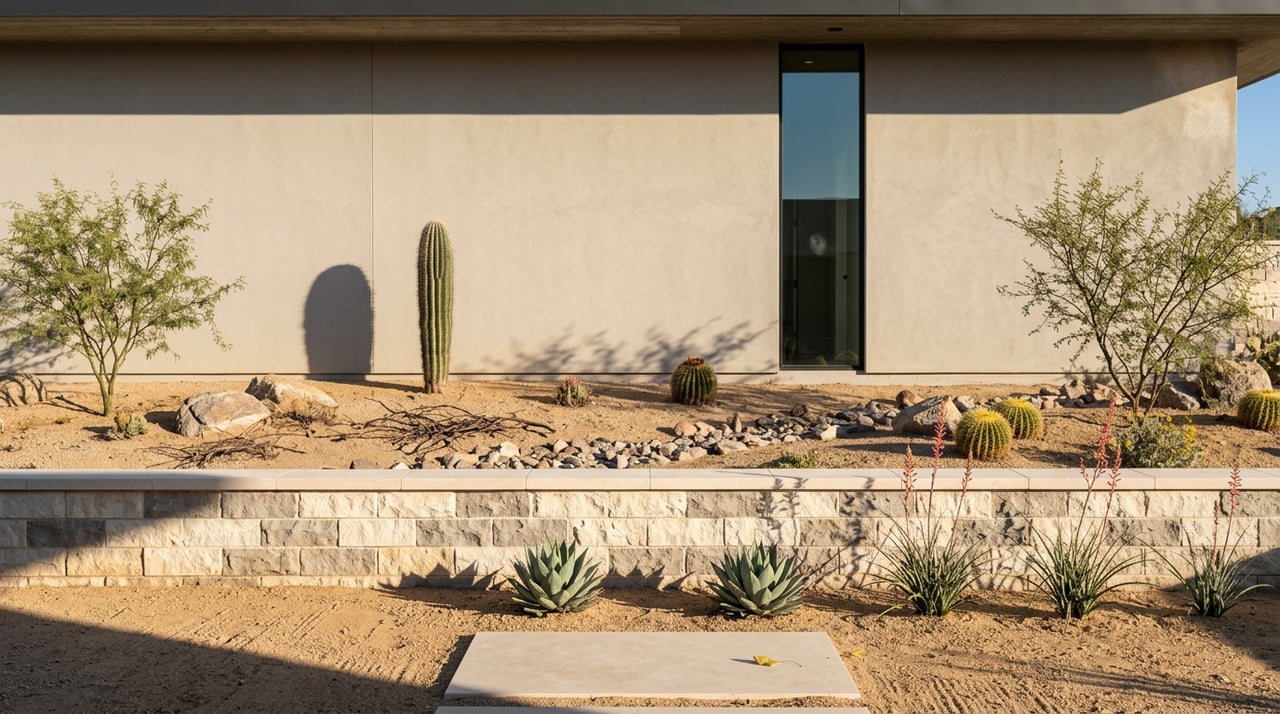
The Two North Scottsdale Diligence Items That Don't Appear on the Listing
July 16, 2026
July 16, 2026
The MLS sheet tells you the lot is 1.4 acres. The satellite view agrees. The seller's disclosure is clean. And then, three weeks into escrow, a buyer learns that roughly a third of the parcel is legally undisturbable, that a previous owner already violated the rule, and that curing the violation is now their problem. A second buyer, closing on a hillside home a mile away, learns the septic clock started six months before their offer was written and no one told the seller.
Both stories play out in North Scottsdale every month. Neither involves the house. Both involve documents recorded at the county that override the purchase contract. If you are buying or listing north or east of the Central Arizona Project canal, these are the two diligence items to run in parallel with the standard home inspection, because the friction they create is local, it is well-documented, and it does not appear in a Zillow snapshot.
Scottsdale's Environmentally Sensitive Lands Overlay covers the land north and east of the Central Arizona Project canal, and it requires that a percentage of each property be permanently preserved as natural area open space, with vegetation, washes, mountain ridges and peaks protected from inappropriate development. The mechanism is called NAOS, and it is not a soft guideline. NAOS is a portion of property deeded to the owner, but with an easement dedicating the land as NAOS which is recorded with the county, and even though you own the property, you are restricted from doing anything on that portion of the property.
How much of the lot is affected depends on the landform category. Under Scottsdale's zoning ordinance at Sec. 6.1060, the minimum NAOS after reductions is fifteen percent in lower desert, twenty percent in upper desert, and forty percent in hillside landforms. Those are floors, not ceilings. Steeper slopes carry higher dedications. A 1.4-acre hillside lot with a 40% NAOS obligation delivers, at most, about six-tenths of an acre of buildable ground once you subtract the easement, and that assumes the balance sits inside an approved construction envelope.
The word "buildable" is the one that surprises people. Inside a NAOS easement, no grading, filling, clearing or excavation of any kind is permitted, and structures, including walls, pools, barbeques, etc., may not be built within an NAOS easement. Trimming a palo verde to open a view is out. So is a fire pit, a putting green, or a second driveway.
That last one is not hypothetical. A North Scottsdale buyer under contract discovered the friction firsthand: during the inspection period the client looked into where the NAOS was located on the property and found that a previous owner had added a second driveway at the back of the property, and in doing so, built the new driveway across the designated NAOS. The City of Scottsdale told them that before they would be able to get a building permit for the additional structure, they would be required to cure the NAOS violation, which would be a relatively expensive process as they would have to remove the driveway and revegetate the area. The seller had not disclosed the encroachment because the seller did not know. The plat did.
Do not accept a verbal description of what the easement covers. The ordinance references and the recorded documents are the only reliable source. Before your inspection contingency lapses, ask escrow or a title officer to produce:
A current boundary and topographic survey that maps the easement against physical improvements is what catches the second-driveway problem. The entire NAOS area shall be permanently maintained as NAOS through easements, donation or dedication to the City and/or conservancy, land trust or similar organization, and if NAOS is located on individual lots, the property owner shall be responsible for maintenance. Translation for a buyer: if the seller's landscaper has been raking gravel or pruning inside the easement for a decade, that maintenance history becomes yours at closing.
A cleaner outcome is possible when the seller has already done the work. Seller-provided surveys, written NAOS determinations, or pre-permit approvals reduce uncertainty, and contract contingencies that allow time to secure a city NAOS letter or confirm feasibility of planned improvements keep the buyer from carrying that risk alone.
The second friction point catches sellers more often than buyers. Any home in North Scottsdale not connected to municipal sewer runs on an on-site wastewater treatment facility, and Arizona has a statewide transfer rule that pre-empts the standard purchase contract.
Under Arizona Administrative Code R18-9-A316, the seller of a property served by a conventional septic tank or alternative system shall retain a qualified inspector to perform the transfer of ownership inspection within six months before the date of property transfer, and the inspector shall prepare a Report of Inspection form and provide it to the seller. The clock does not start when the offer is accepted. It runs backward from the close date, and it caps out at 180 days.
The rule is not negotiable at the contract level. The requirement to have the on-site wastewater treatment facility inspected within six months prior to property transfer is a provision of Arizona rule, and takes precedence over any conflicting terms that may exist in any contract pertaining to the property transfer.
What that produces, practically, is a short list of decisions the seller has to make before listing rather than after opening escrow.
The relevant desert-soil detail sits behind those steps. Extreme summer heat can accelerate the breakdown of components, while the caliche and clay-heavy soils common in the area can reduce drain field absorption capacity over time, and periods of drought followed by monsoon rains can stress system components. A system that looked adequate on paper in 2019 may not pass in 2026, and the seller learns that during the pre-listing inspection or during escrow. The difference between those two timelines is who has leverage.
Both diligence items share a structure that catches out-of-state parties off guard. Each is governed by a recorded or statutory instrument that outranks the purchase contract. Each operates on a timeline that runs backward from the close date rather than forward from the offer. And each turns on documents the listing agent does not necessarily have on the desk when the sign goes in the yard.
The reader who takes one operating principle from this piece should take this one: in North Scottsdale, the constraint that costs the most money is usually the constraint that was already in place before the current owner bought the home. Confirm the recorded documents first. The house inspection is the easy part.
Can NAOS be moved or released? It is possible to move the NAOS to another location on the property, but this involves surveys and detailed submission to the city, and it may or may not be approved. Treat any planned relocation as speculative until you have it in writing.
Does the septic inspection requirement apply to brand-new construction? An ownership inspection is not required when the on-site system has not been put into service, such as buying from a builder, but the new owner will still need to submit a Notice of Transfer form and fee.
If the seller already has a Report of Inspection from earlier in the year, is that enough? Only if closing falls inside the 180-day window from the inspection date. Outside of it, the inspection must be redone.
If you are writing an offer on a home north of the CAP canal, or preparing to list one, the recorded documents deserve the same attention as the walk-through. Taylor at Taylor Mason Residential works these two workflows in parallel from the first showing, so the surprises surface early, when there is still room to price them, negotiate them, or walk away with your earnest money intact.
Stay up to date on the latest real estate trends.





I approach real estate the same way I approached the restaurant and hospitality world—as a service profession first. With a background spanning executive chef leadership, international business, and high-stakes negotiations, I bring a level of care, adaptability, and calm that my clients immediately feel.

TAYLOR MASON - RESIDENTIAL
ADDRESS 4222 N Marshall Way Ste A Scottsdale AZ 85251